
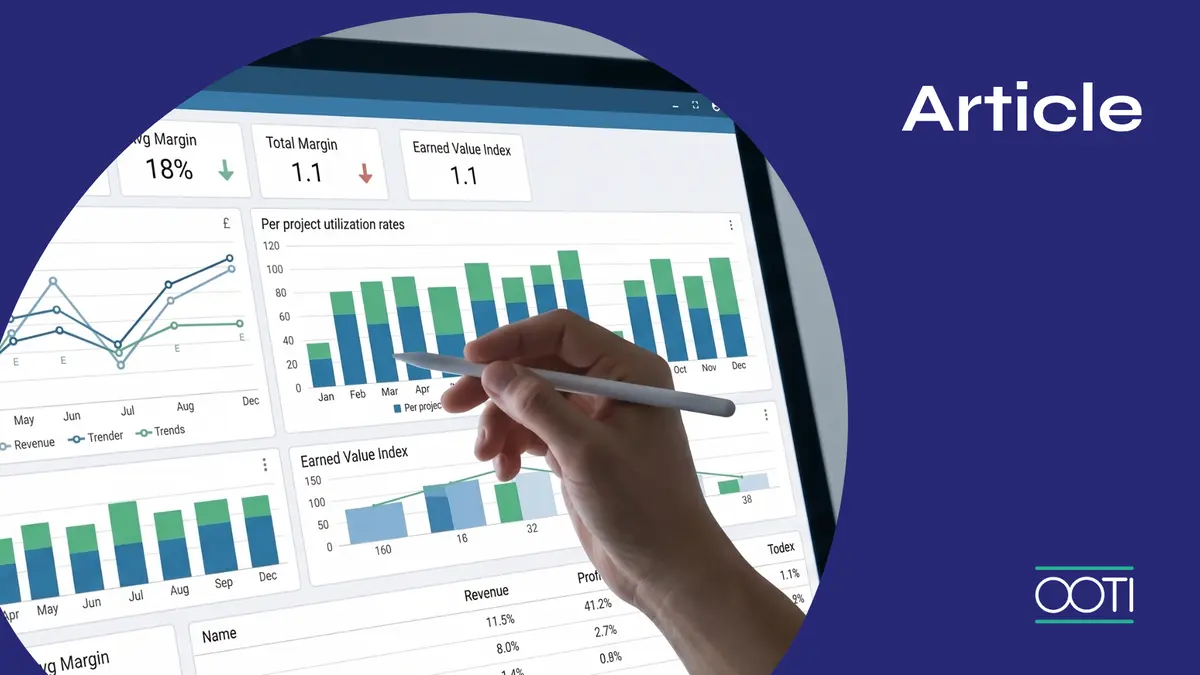
From Excel to Management Software : The Guide for Architecture Firms
.avif)
For a long time, Excel served architecture firms well. Fee tracking spreadsheets, phase schedules, time logs by team member, the tool accompanied generations of architects. But as projects grow more complex and teams expand, the limits of this approach become impossible to ignore. Moving away from Excel is not a question of trends; it is a strategic decision, one that directly serves your firm's profitability and peace of mind. Here is why, and how.
How Excel is holding your architecture firm back
Excel has long been a reliable ally: fee schedules, phase tracking, time spent per team member, everything goes in. But as projects accumulate, teams grow, and assignments become more complex, one reality sets in: Excel cannot keep up.
- A client amendment? Multiple files to update.
- A profitability estimate? Scattered data to consolidate.
- Real-time visibility? Impossible without re-entering data.
This is not a question of misusing the tool, it is a hard structural limit. You spend more time reconstructing information than actually steering your projects.
Why move away from Excel in an architecture firm?
The decision to leave is usually the result of accumulated friction.
The telltale signs
Certain patterns appear consistently in firms that have hit the limits of Excel:
- Files multiply and no one knows which version is current.
- Every change introduces the risk of error.
- You piece together your figures at month-end, with no visibility in between.
- Your teams spend time on data entry rather than production.
- You lack visibility into the real profitability of your projects.
At this stage, the spreadsheet is quietly and continuously costing you time.
Excel vs. management software : the comparison for your architecture firm
The comparison is clear: across every operational function of a firm, Excel and a dedicated management solution for architects do not offer the same level of response.
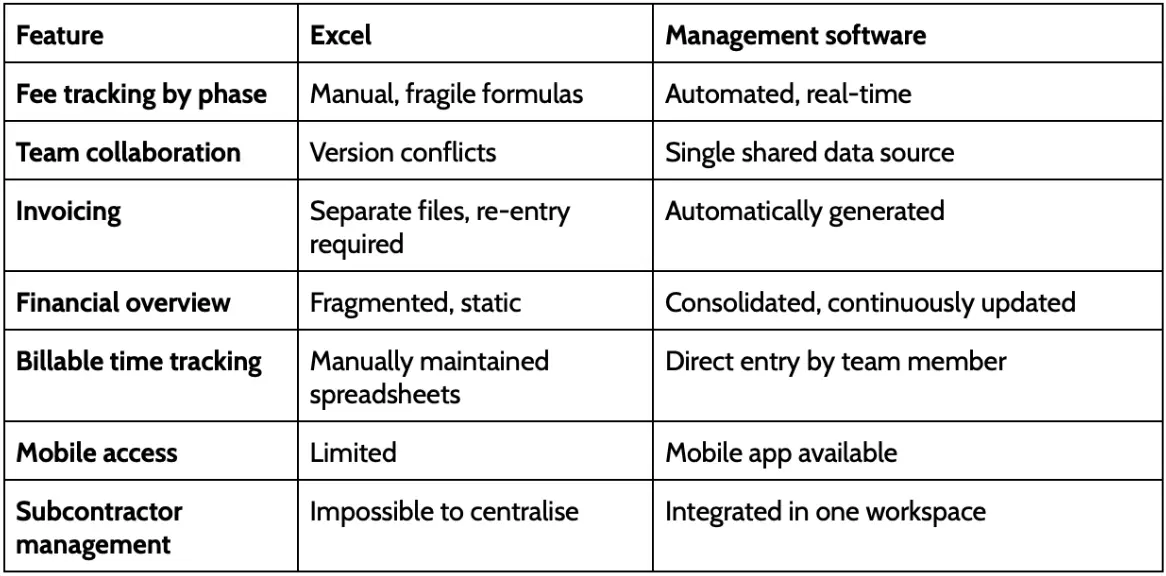
Excel is a calculation tool, not a management tool. That distinction is fundamental for a growing firm.
What you can finally do with a proper management solution
Imagine running all your projects from a single place. No scattered files, no lost data, no month-end scramble to manually piece together your numbers. Here is what a platform like OOTI changes in practice, from the very first weeks:
- Centralised data: projects, time, fees, invoicing.
- Real-time project tracking: progress, budget, remaining work.
- Reliable invoicing: no more re-entry, fewer missed items.
- Team accountability: each person logs their time directly.
- Profitability visibility: by project, by phase, by team member.
All accessible from any workstation or from the mobile app, so your data follows you all the way to the site.
Improving collaboration and productivity
In practice, a shared management platform changes everything day to day. Each team member logs hours directly in the tool. Expense reports are added as they arise. Invoices are automatically generated based on the billing schedule. Subcontractors and co-contractors are tracked in the same workspace.
No more consolidating files at the end of the week. No more chasing team members for their data. Information flows structured, reliable, in real time.
Making the transition to a dedicated tool : the 3 questions to ask before choosing
Switching tools solves nothing if the fundamentals are not clear first. Before comparing solutions on the market, take the time to examine how your firm currently operates, where is time being lost? Where are the blind spots financially?
1. What types of projects do you run, and what are your mission phases ?
Not all projects are managed the same way. Residential, single-family homes, public facilities, and renovations each involve different levels of complexity, timelines, and stakeholders.
A relevant tool must allow you to model your mission phases precisely, attach deliverables, deadlines, and fees to each one, and track progress, while retaining flexibility.
The goal is not to "fit into a tool," but to have a framework that mirrors your practice and makes deviations between forecast and actual visible.
2. Who needs access to what within your firm ?
Information flow should be smooth, without being uncontrolled. A project architect does not have the same needs as a project manager or a firm principal. Your tool needs to support granular access management:
- Visibility over projects.
- Data editing rights.
- Access to financial indicators.
A poorly configured tool quickly becomes a source of confusion: too much access dilutes information, too little creates bottlenecks. Access rights are not a technical detail, they determine your ability to share useful information, hold teams accountable, and protect sensitive data.
3. Are you looking for a partial tool or an all-in-one solution ?
Using multiple specialised tools can address isolated needs, but it fragments the overall picture (scattered data, duplicate entries, incomplete view of profitability).
An all-in-one solution, by contrast, centralises the key dimensions of your business: project management, time tracking, fees, invoicing, and financial indicators.
This shift in perspective is structural. You are no longer simply managing projects, you are steering the overall performance of your firm, with a clear, up-to-date read at all times.
FAQ : transitioning from Excel to a management platform
Is the transition difficult to implement ?
Far less than you might expect. A 100% cloud-based SaaS platform requires no heavy installation or complex migration. Your team can access it from day one, from their workstation or the mobile app.
Do you have to abandon Excel overnight ?
No. Plan for a transition period during which both tools coexist, giving your team time to get comfortable and historical data time to be integrated.
Is OOTI suited to all firm sizes ?
Yes. Whether you are a two-person practice or a firm of more than 20, OOTI offers plans adapted to your scale. For teams of more than five users, a personalised quote is available on request.
Key takeaways
Switching to a dedicated management platform is not a luxury reserved for large firms. It is a straightforward decision, accessible to practices of all sizes. Billable time tracking, phase-level profitability, real-time financial visibility, centralised collaboration — these capabilities are no longer optional. They are the foundation of a firm that moves forward with confidence.
Want to learn more about transitioning to the right management solution for your firm? Discover how OOTI supports architects every day.
Related Posts













.avif)